



Colorectal Cancer
Learn About Colorectal Cancer

HOW PREVENTABLE IS COLORECTAL CANCER?
The science is clear: Small choices about what we eat and how much we move — choices each one of us makes every day — could prevent half of the cases of colorectal cancer that occur in the US every year.
This means that if all Americans eat healthier diets, moved more and stayed lean, nearly 72,000 cases of colorectal cancer every year would never happen.
HOW YOU CAN HELP
Donate Now to Support Cancer Research and Education
STAY INFORMED
Register to receive updates on AICR Research
WHAT ARE COLORECTAL CANCER'S MAJOR RISK FACTORS?
| Weight: As you gain body fat, your risk for colorectal cancer increases. |
Alcohol: Risk for colorectal cancer increases as alcohol intake increases. |
| Inactivity: Regular physical activity protects against colorectal cancer, but a sedentary lifestyle increases your risk. | Age: The older you are, the greater your risk. |
|
Red Meat: Diets high in beef, pork and lamb increase colorectal cancer risk, which is why AICR recommends limiting red meat to 18 ounces (cooked) per week. |
Processed Meats: Regular intake of even small amounts of cold cuts, bacon, sausage and hot dogs have been shown to increase colorectal cancer risk, which is why AICR recommends avoiding these foods. |
HOW COMMON IS COLORECTAL CANCER?
Colorectal cancer is the third most common cancer in the US. Nearly 143,500 new cases of colorectal cancer occur annually. Just over half — nearly 73,500 — occur in men, while just over 70,000 occur in women.
Colorectal cancer is the third deadliest cancer in the US, killing almost 52,000 Americans every year.
As obesity rates have increased, the number of colorectal cancer cases has increased as well.
RELATED ARTICLES
- CRU: Tea May Protect Against Digestive Cancers
- CRU: B Vitamins Neither Harm Nor Help Colorectal Cancer Risk
- CRU: Updated Estimates: Preventing Half of Colorectal Cancers
- CRU: Carbs Not a Risk for Colorectal Cancer
- CRU: Glucose Levels Linked to Colorectal Cancer Risk
- CRU: New Evidence; New Estimates
- CRU: Lab Study: Purple Sweet Potatoes May Protect Against Colon Cancer
- CRU: For Men’s Health Week: Reducing Your Cancer Risk
- eNews: Spring Exercise Trends
- eNews: More Cancer Survivors; More Research on Living Healthy
- eNews: Double Duty Grilling: Flavorful, Cancer Preventive Foods
FOCUS ON THE RISK FACTORS YOU CONTROL

A Menu for
Colorectal Cancer Prevention
Learn about AICR’s simple, visual, award-winning approach to meal planning that helps you lower your cancer risk – and your weight.
AICR’s new web resource keeps you up-to-date about the latest research on foods that belong at the center of your New American Plate.
To lower your risk for colorectal cancer, make everyday choices that will help you stay at or get to your healthy weight. This is the most important step you can take to help prevent this particular kind of cancer.
Find your "healthy weight" using the AICR Body Mass Index (BMI) calculator.
Moving more and eating well will help you achieve your healthy weight.
Avoiding alcohol and tobacco also help lower your risk.
MOVE MORE
Aim to get your body up and moving for at least 30 minutes every day. So try anything that:
- Makes your heart beat faster
- Makes you breathe more deeply
- You already enjoy doing
EAT WELL
| Get More: | Get Less: |
|
|
| A good rule of thumb:
Always fill at least 2/3 of your plate with plant foods, and let animal foods (meat and dairy) take up the rest. |
|
IF YOU CHOOSE TO DRINK, LIMIT ALCOHOL
If you do decide to drink, keep to no more than 1 standard drink (12 ounces of beer, 5 ounces of wine, 1.5 ounces of liquor) per day.
What the Research Shows
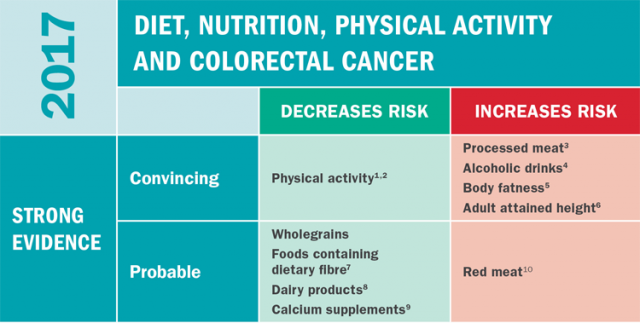
FOOD, NUTRITION, PHYSICAL ACTIVITY, AND CANCER OF THE COLORECTUM
| ||
|---|---|---|
| Source: Food, Nutrition, Physical Activity, and the Prevention of Cancer: a Global Perspective and the 2012 CUP Report on Colorectal Cancer | ||
| STRENGTH OF CURRENT EVIDENCE | DECREASES RISK |
INCREASES RISK |
| CONVINCING Effect on Risk: |
Physical activity Foods containing fiber |
Body fatness Red meat Processed meat Alcohol (men) |
| PROBABLE Effect on Risk: |
Garlic Diets high in calcium Milk |
Alcohol (women) |
What’s the Link?
- Excess Body Fat Raises Colorectal Cancer Risk
- Being overweight and obese increases blood levels of insulin and related hormones that can encourage the growth of cancer.
- Excess fat also creates a pro-inflammatory environment in the body that can contribute to the growth of cancer.
- Red Meat Raises Colorectal Cancer Risk
- Red meat contains heme iron, which has been linked to the kind of cellular damage that increases risk.
- The red meat stimulates the production of carcinogenic N-nitroso compounds in the body.
- Meat cooked at high temperatures produces heterocyclic amines (HCAs) and polycyclic aromatic hydrocarbons (PAHs), both are potent carcinogens.
- Processed Meat Raises Colorectal Cancer Risk
- Nitrates are added to many processed meats; they contribute to the production of N-nitroso compounds that can damange the lining of the gut.
- Many processed meats are high in salt and nitrites, both of which are associated with increased risk.
- Alcohol Raises Colorectal Cancer Risk
- The body coverts alcohol into acetylaldehyde, a potent carcinogen.
- Alcohol may act as a solvent, making it easier for carcinogens to penetrate the cells lining the colon.
- Alcohol can adversely affect how efficiently the body repairs DNA damage and defends against free radicals.
- Statistically, heavy drinkers tend to have poor diets, which increases their cancer risk.
- Physical Activity Lowers Colorectal Cancer Risk -- Both Directly and Indirectly
- DIRECTLY: Being active helps regulate hormone levels and reduces inflammation.
- INDIRECTLY: Active people are less likely to be overweight or obese; as noted above, excess body fat raises risk for colorectal cancer -- and six other kinds of cancer as well.
- Foods Containing Fiber Lower Colorectal Cancer Risk
- In 2012, the AICR/WCRF CUP panel concluded that the evidence linking foods containing fiber with lower colorectal cancer risk had grown stronger in the years since the 2007 expert report. Evidence that dietary fiber protects against colorectal cancer is now convincing.
- Besides their fiber, plant foods contain a wide variety of substances that have been linked to lower risk for cancer, including carotenoids, selenium, lycopene and many more.
- Garlic Lowers Colorectal Cancer Risk
- Both the AICR/WCRF expert report and the CUP cite several studies in which subjects who ate the most garlic had lower colorectal cancer risk than subjects who ate the least. And in many laboratory studies, garlic and its components (such as allyl sulphur compouns) have show the ability to slow and stop the formation of colon tumors.
About the CUP
The AICR/WCRF Continuous Update Project (CUP) is the world's largest ongoing cancer prevention research project. It is a living database of the global scientific evidence on diet, physical activity, body weight, and cancer.
AICR-Supported Studies
LOOK FORWARD WITH HOPE
Today, your chances for overcoming colorectal cancer and returning to an active and full life are the best they've ever been.
But throughout your treatment, and after it is over, you will face many everyday questions. AICR can help.
AICR’s CancerResource: A Program for Those Living with Cancer is a free kit of information specifically for the newly diagnosed cancer patient.
YOU ARE NOT ALONE
There are now over 1.1 million colorectal cancer survivors in the US alone, living longer, healthier lives than ever before.
See below for selections from AICR's CancerResource. Or read the complete CancerResource flipping book online.
BEFORE TREATMENT
DURING TREATMENT
- Questions to Ask Your Oncologist About Your Treatment Worksheet
- Questions to Ask About Nutrition During Treatment
- Evidence-based advice on managing nutrition-related side effects of treatment
- Staying active during treatment
AFTER TREATMENT
- AICR’s Recommendations for Cancer Prevention
- Healthy or Harmful? Frequently Asked Questions about Life After Cancer
More AICR Materials for Colorectal Cancer Survivors
In-depth brochures on cancer survivorship; read online or order a free copy.

Join the Fight Against Colorectal Cancer
Colorectal cancer is the third most common cancer in the US yet the choices we make every day could prevent half of these cases each year. Your support for AICR's cancer research, survivorship, and education programs will help us get one step closer to preventing colorectal cancer and saving lives.
Donate Today!
Your gift will help fund emerging research on colorectal cancer and other cancers and improve the quality of health for colorectal cancer patients and survivors.
Honor Someone Facing Colorectal Cancer
Make a gift in memory of a loved one. Your gift will help fund research and survivorship programs for those with colorectal cancer and other cancers for years to come.
Give in Memory of a Loved One
Make a gift in memory of a loved one. Your gift will help fund research and survivorship programs for those with colorectal cancer and other cancers for years to come.
Do You Have a Question? Ask the Expert!
We’ve compiled a list of some of the most common questions we receive in our FAQ below. Have a question about diet and food and cancer prevention? Ask your question using this form. We will post some of the answers to the questions we receive that have the most benefit to the most people.
Ask Your Question
Frequently Asked Questions (FAQ)