


AICR
Key Takeaways:
- Most cancers still occur in older adults. However, the number of younger adults diagnosed with some types of cancer has increased in recent decades.
- An AICR analysis found significant increases in cases of kidney, colorectal, uterine, pancreatic and breast cancers among U.S. adults under age 50. Kidney cancer showed the largest change.
- We do not yet know what is driving these trends. Changes in health, lifestyle, the environment and how cancers are diagnosed may all play a role.
What Are Early-Onset Cancers?
Most cancers occur in adults over the age of 50. However, recently more cancers are being diagnosed in people aged under 50. These are more pronounced in the U.S. and in other high-income countries. These have been named “early-onset cancers.”
This does not mean that cancer is suddenly common in younger people. But it does mean that some cancer types are being seen more often in younger ages than they were in past decades. Age is still one of the most important cancer risk factors.
How Did We Analyze the Data?
AICR used data from the National Cancer Institute’s SEER program to examine new cases of 12 cancer types among Americans under 50 between 2000 to 2023. We then tested whether the changes over time were likely to reflect a real pattern rather than chance.
What Do the Numbers Tell Us?
Five cancer types showed significant increases in the U.S.:
- Kidney cancer: Number of new cases rose from 2,322 in 2000 to 4,784 in 2023, an increase of 106 percent. The age-adjusted* incidence rate also more than doubled, from 2.5 to 5.3 cases per 100,000 people.
- Colorectal cancer: Number of new cases rose from 5,395 to 9,352, an increase of 73 percent. Incidence rate rose from 5.9 to 10.2.
- Uterine cancer: Number of new cases among women rose from 2,300 to 3,673, an increase of 60 percent. Incidence rate rose from 5.0 to 7.9.
- Pancreatic cancer: Number of new cases rose from 933 to 1,441, an increase of 54 percent. Incidence rate rose from 1.0 to 1.6.
- Breast cancer: Number of new cases among women rose from 19,884 to 23,621, an increase of 19 percent. Incidence rate rose from 42.9 to 51.7.
*Age adjustment allows rates from different years to be compared as though the population had the same mix of age groups. Because we used age-adjusted incidence rates, we can be confident that the rise in cancers we are seeing among under age 50 is not simply because there are more people or because the population’s age profile has changed.
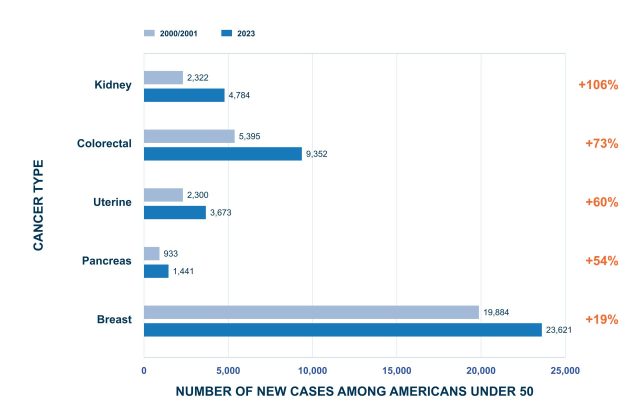
Kidney cancer had the largest change in case numbers. The number of cases more than doubled between 2000 and 2023. This matters because a lot of the public discussion about early-onset cancer has focused on colorectal and breast cancers. Our findings show that the story is much bigger. Kidney, uterine and pancreatic cancers need attention, too.
Dr. Giota Mitrou, Executive Director of Research and Policy at AICR, says: “These figures should make us pause and think because this current trajectory is concerning. Our analysis shows that new kidney cancer cases among Americans under age 50 have more than doubled since 2000. We are also seeing increases in several other cancers that are not usually thought of as diseases of younger adulthood. Behind every figure is a person facing cancer earlier than they, their family and often their doctor would expect.”
Why Are Early-Onset Cancers on the Rise?
Like cancer diagnosed at any age, cancer before the age of 50 can be disruptive. If the patterns of early-onset cancer are changing, it is important to understand why.
As well as analyzing the data, we looked at what might be causing increases in cancer among young people. In short, we do not completely know what is causing it. Most likely, there is no simple answer.
We know that cancer develops through a mix of genes, age, exposures and other factors. Several factors may also work together over time. The process may start in childhood or young adulthood. The possible reasons may also differ by cancer type.
Researchers are studying different factors that could play a role in the risk of developing cancer earlier in life, including:
- Eating patterns
- Physical activity
- Body weight
- Alcohol use
- Smoking
- Environmental factors e.g. air and water pollution, chemicals and plastics
- Changes in cancer screening, testing and diagnosis.
Researchers are also trying to understand who is most affected and if the risk differs between diverse groups. The aim of this research is to improve prevention of early-onset cancers, increase awareness, detect these cancers earlier and give more personalized treatment.
What is Happening Inside the Body?
Cancer develops when changes in cells allow them to grow out of control. Genes, hormones, inflammation, the immune system and other processes can all be involved.
Researchers are studying whether exposures earlier in life can change these systems in ways that affect cancer risk many years later. For example, more children and young adults are living with overweight and obesity than in past decades. Researchers are studying whether developing excess body weight earlier, and living with it for longer, could affect cancer risk later in life. They are also asking whether early-onset cancers differ from cancers of the same type found in older adults.
The answers are not clear yet. A better understanding of the biology may help researchers find new ways to prevent cancer, spot it earlier and choose the best treatment.
Are Younger People Now at High Risk Overall?
No. Cancer is still much less common in younger adults than in older adults. The worry is that the pattern is moving in the opposite direction for some cancers. Even a small change in a less common disease can affect thousands of people. A cancer diagnosis before 50 may also come during work, parenting, caregiving or plans to start a family. Its effects can reach far beyond medical care.
Professor Yikyung Park, ScD, a Scientific Advisor to AICR, says: “This analysis demonstrates significant increases in several site-specific cancers. We do not yet fully understand what is driving these trends, but it is unlikely that there is a single underlying cause. That is why the next priority is to build a stronger evidence base through research. This will help us to better understand why these cancers are becoming more common and, importantly, where prevention efforts can have the greatest impact.”
What Happens Next?
Researchers around the world are looking into early-onset cancers and trying to understand why younger generations are being affected differently to older ones.
AICR and the World Cancer Research Fund network have been researching cancer prevention for over 30 years. We will continue to support studies that explore why more younger adults are developing cancer and what can be done to reduce their risk.
For example, AICR grantee Dr. Tomotaka Ugai, PhD, at Brigham and Women’s Hospital is exploring why colorectal cancer is rising in people under 50 by looking at differences in tumors, the immune system and gut bacteria, and how lifestyle factors may affect risk. Studies like this could help us understand who is most at risk and find better ways to prevent cancer in younger adults.