

Project Description
“Metabolic dysfunction-associated steatotic liver disease (MASLD), commonly referred to as fatty liver disease, is a major contributor in the development of liver cancer. Cultural and linguistic barriers, limited access to healthcare, and other social drivers of health should not limit the ability to participate in early screening and preventative care to reduce liver cancer risk factors. This research study will provide Latino communities with free screening for fatty liver disease using a portable ultrasound and for those who screen positive for MASLD, engage them in a 12-week Food is Medicine intervention to provide access to health-promoting foods and behavioral lifestyle education. I am incredibly grateful to the American Institute for Cancer Research for providing support to reduce health disparities, especially among vulnerable populations who experience disproportionate liver cancer morbidity and mortality.”
– Dr. Marcela D. Radtke
Background:
Metabolic associated steatotic liver disease (MASLD), also known as fatty liver disease, is a major risk factor for liver cancer. Fatty liver disease affects Latino communities at higher rates, especially those who have limited access to healthy foods. Diets high in added sugars, unhealthy fats, and salt, along with low intake of fruits, vegetables, and whole grains can increase the risk of developing MASLD. In many cases, diagnosing MASLD requires expensive tests that are often done only after the disease has already worsened. Because of this, many people, especially those with limited access to health care, are diagnosed too late when there are fewer options to prevent more serious outcomes like liver cancer. This highlights the need for quick and accessible ways to detect fatty liver disease in community settings.
Aims and Objectives:
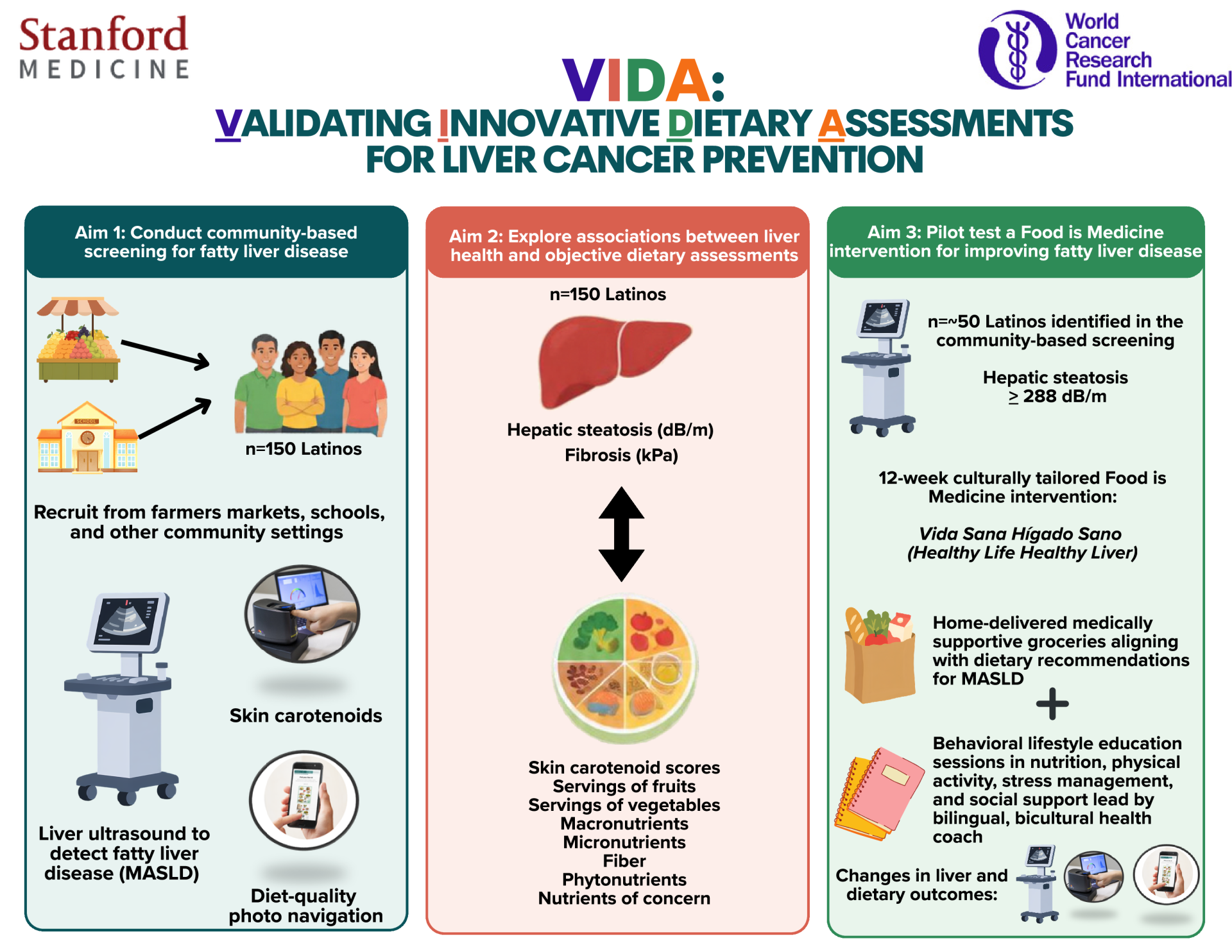
This study aims to conduct community-based screening for identifying MASLD and pilot test Vida Sana Hígado Sano (Healthy Life, Healthy Liver), a 12-week intervention designed to address modifiable risk factors for liver cancer prevention among Latinos with MASLD.
We aim to:
- Examine the acceptability and feasibility of a community-based screening program for MASLD among around 150 individuals of Latino descent;
- Explore associations between diet quality and liver health;
- Pilot test a 12-week culturally tailored intervention among 50 Latinos with MASLD and food insecurity.
Methods:
At screening events, around 150 individuals of Latino descent will be offered liver screenings. Those who screen positive for fatty liver disease will be invited to participate in a 12-week Food is Medicine program called Vida Sana Hígado Sano (Healthy Life, Healthy Liver), which is designed for helping participants improve their diet and lifestyle behaviors, such as sleep and stress. Vida Sana Hígado Sano includes nutrition and lifestyle education, health coaching and weekly deliveries of healthy groceries.
The study will use three simple, non-invasive tools to assess changes in liver health and body weight:
- The FibroScan® to assess liver fat and stiffness
- The Veggie Meter®, which measures fruit and vegetable intake by shining a light through the tip of the finger to quantify carotenoids
- Diet ID™ to evaluate diet quality using images of different foods.
Potential Impact:
By measuring changes in liver health, diet, and body weight, this study aims to find practical, culturally relevant ways to prevent fatty liver disease and reduce the risk of liver cancer in communities that are most affected.
Scientific Novelty:
The proposed intervention will utilize three innovative, objective measures of dietary intake that have yet to be widely implemented. Both the Veggie Meter® and the FibroScan® are non-invasive, portable devices that provide clinical results in real-time and are suitable for community-based settings. In addition to the novelty of the measurement tools, participants with MASLD have yet to be the population of interest in dietary interventions such as this.