



Nigel Brockton
Key Takeaways:
- The CO21 CHALLENGE Trial found that a structured exercise program after chemotherapy led to a 28 percent lower risk of recurrence in colon cancer survivors compared to usual care.
- This is the first randomized controlled trial (RCT) to show that exercise directly improves survival in colon cancer patients. It confirms what observational studies have long suggested.
- The results were presented at a recent conference and made headline news. Experts say the CHALLENGE Trial marks a shift from viewing exercise as a “nice to have” to a “need to have” in cancer care.
A new study called the CO21 CHALLENGE Trial showed that exercise after colon cancer treatment resulted in longer disease-free survival.
Colon cancer survivors who took part in a three-year structured exercise program had a 28 percent lower risk of cancer recurrence or a second cancer. They also had a 37 percent lower risk of death compared to usual care.
These findings were shared at the 2025 Association of Clinical Oncology (ASCO) Annual Meeting. They were also published in the New England Journal of Medicine.
The ASCO Annual Meeting is the world’s largest oncology conference. It attracts over 40,000 attendees from around the world. Every year, ASCO highlights the latest advancement in treatments. It also shares the directions that have the greatest potential for progress and patient impact.
Spotlight on Exercise
The CO21 CHALLENGE Trial pulled back the curtain on cancer-fighting a weapon that has been hiding in plain sight: physical activity. The results of the trial showed improvement in disease-free survival and overall survival in colon cancer survivors in the aerobic exercise intervention group. This trial is the first gold standard RCT to show what has long been indicated from observational studies. This is a big deal!
The impact of exercise on cancer outcomes has been a topic of great debate. Observational research has shown improvements in survival and quality of life linked to higher levels of physical activity. However, observational study designs are limited. They do not show cause and effect. Plus, they are hard to implement in clinical settings due to concerns that the reported effects may not truly reflect the impact of exercise (and may be due to something else).
World Cancer Research Fund (WCRF) International CUP Global Research
Over the past few years, WCRF International has done extensive reviews through its flagship Global Cancer Update Programme (CUP Global). CUP Global includes partnerships with American Institute for Cancer Research, WCRF in the UK and Wereld Kanker Onderzoek Fonds in the Netherlands.
The CUP Global reviews look at the extent to which diet, nutrition and physical activity impact in people after a diagnosis of breast and colorectal cancers with regards to:
- Cancer-specific mortality
- All-cause mortality
- Risk of cancer recurrence
- Health-related quality of life
An expert panel judged the strength of this CUP Global evidence. There were some limitations. Still, detailed recommendations were made to strengthen future research. One of the key recommendations was for well-conducted trials to look at the impact of nutrition or physical activity. The CHALLENGE trial is therefore very timely.
The CUP Global analysis was published in the International Journal of Cancer. It was cited several times in the CHALLENGE trial manuscript. The CUP Global analysis compared highest to lowest levels of activity. We found that all-cause mortality was reduced by 23 to 40 percent depending on physical activity exposure.
The summary estimate for studies that assessed activity dose were measured in MET hours per week. A 10 MET hour per week increase in activity was linked to a 24 percent reduction in all-cause mortality. A change of 10 MET hours per week was also the intervention goal in the CHALLENGE trial. The effect sizes in this first gold-standard RCT are remarkably well aligned with the CUP Global analyses of observational studies.
During the presentation of the trial results at ASCO, the authors shared this chart. It includes the treatment benefits from approved therapies for colon, lung and breast cancer:
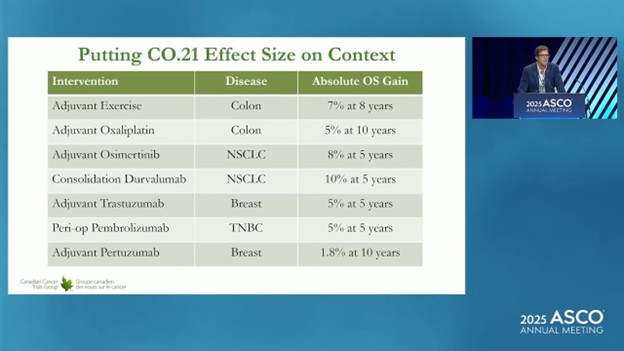 With seven to eight percent gains, you can see that exercise compares very favorably with other approved therapies in terms of absolute overall survival gain.
Collecting Clinical Trial Evidence
The CHALLENGE trial confirms the clinical benefits that had been reported from observational studies. However, previous randomized controlled trials (RCT) have also hinted at the accuracy of the results from observational studies. For example:
- The LEANer trial was published in 2023. It showed that triple negative breast cancer patients randomized to a diet and physical activity intervention before chemotherapy had a 53 percent higher rate of treatment success (eliminated cancer cells).
- A trial published in June 2025 showed that an exercise program during and after chemotherapy increased the immune system responses in esophageal cancer patients.
WCRF will fund the Optimus trial in the UK. Dr. David Bartlett and Professor Adam Frampton at the University of Surrey will lead this study. It was proposed due to these findings.
Next Steps
Dr. Kerry Courneya co-led the CHALLENGE trial. At ASCO, he said that these results could change practice for high-risk stage II and stage III colon cancer. He expressed reservation that these results could be generalized to other sites and cancer stages. But he was optimistic that similar trials could be done more quickly than the CHALLENGE trial by taking advantage of newer methods. This could include using remote exercise assessments or activity trackers.
Dr. Courneya noted that “support from funding agencies like WCRF/AICR is critical to moving this field forward because of limited access to funding for lifestyle research.”
AICR has recently funded a project that is linked to the CHALLENGE Trial. It is being led by Dr. Kristin Campbell at the University of British Columbia in Canada. It will look at how muscle and fat tissue respond to exercise and how that might contribute to the observed survival benefits.
The response to the CHALLENGE Trial has made media headlines. Cancer researchers, doctors and patients are also excited by the news. This suggests that adding exercise as an additional part of treatment will gain further momentum. While more trial data will be needed to support broader implementation, we are likely leaving the “nice to have” approach to exercise oncology and entering the “need to have” phase!