



Somewhere in the difficult miles of marathon training, Dr. Jonathan Bricker, PhD, sees the same challenge he has studied throughout his career: how do we keep moving toward what matters when every instinct tells us to choose comfort?
Dr. Bricker has spent 23 years helping people make healthier choices that reduce their cancer risk. A Licensed Clinical Psychologist, Professor and the Endowed Chair in Cancer Prevention at Fred Hutch Cancer Center in Seattle, Washington, he studies how people can make lasting changes to lifestyle behaviors, including smoking cessation, improved nutrition and increased physical activity.
Through the Health and Behavioral Innovations and Technology (HABIT) Lab, Dr. Bricker and his colleagues develop interventions designed to make evidence-based behavior change more accessible to communities on a larger scale.
Lasting behavior change often comes down to something deeper than willpower. Dr. Bricker believes it’s about making choices that reflect long-term values, even when those choices are uncomfortable in the moment.
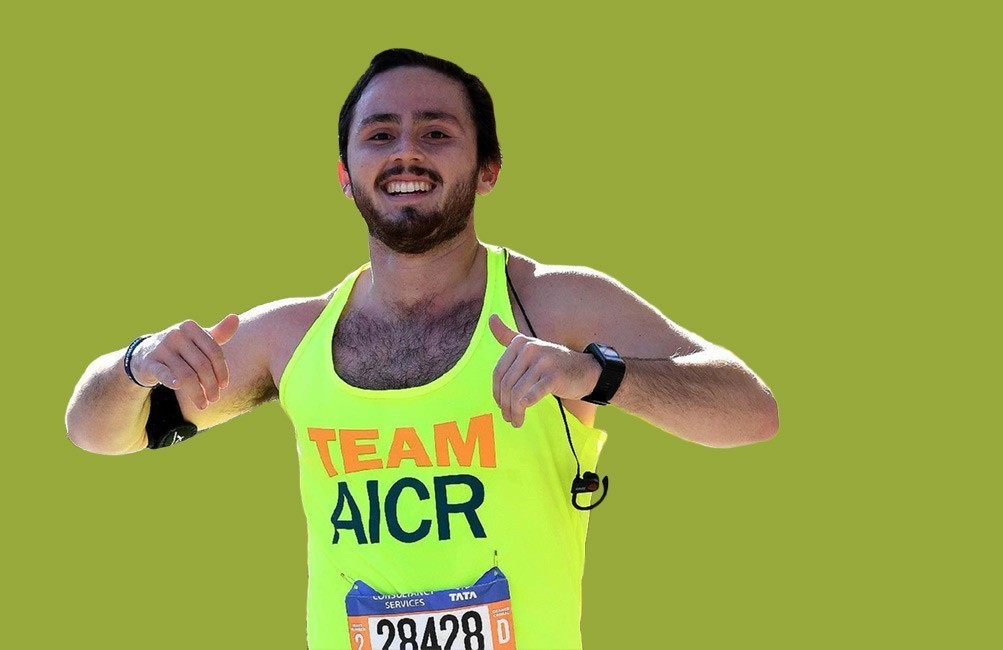
Now, Dr. Bricker is putting those same principles into practice as he trains for the 2026 Berlin Marathon with Team AICR, AICR’s community of runners and endurance athletes raising funds to advance cancer prevention through research and education.
We recently spoke with Dr. Bricker about his career, his passion for behavior change and why being part of Team AICR was a natural fit.
What first inspired your career in cancer prevention?
My career in cancer prevention began with a simple question that has stayed with me ever since: Why do people keep doing things they know are harming them, and how can we help them change in ways that actually last? Early in my career, I realized that preventing cancer isn’t just about discovering new treatments – it’s also about helping millions of people make small, sustainable changes in their everyday lives. That insight drew me to behavior change science. Over the past 23 years, I’ve focused on developing practical, evidence-based digital and telehealth tools that help people stop smoking, become more physically active, and eat more healthily. When those changes happen at scale, they have the potential to prevent countless cancers before they ever begin.
After helping people build healthier habits for more than two decades, what’s one lesson that’s stayed with you?
We live in a world where we have the ability to avoid discomfort and seek immediate pleasure. Being comfortable is part of our human programming. The question is: if your goal is long-term good health, how do you let go of immediate comfort in the service of your values? That question applies whether you’re trying to quit smoking, improve your diet, become more physically active or train for a marathon.
You’ve completed the Chicago, California International, Los Angeles, and London Marathons, and have even climbed Mount Kilimanjaro. How did running become such an important part of your life?
I’ve been running since I was 12 years old, but becoming a marathon runner wasn’t always part of the plan. About eight years ago, a former high school cross-country teammate invited me to run the Los Angeles Marathon. I wasn’t sure I could do it, but I decided to give it a try.
It was such an epic experience: I did something that I didn’t think I could do!
What surprised me most wasn’t simply finishing the race. It clicked that it’s not about me. It’s about the larger community of runners that I was joining.
Why did you choose to run for AICR?
If I’m doing something bigger than myself, how can I use this experience? For me, running became even more meaningful when I could put it in service of something larger than myself.
I’ve spent my career doing research focused on diet and physical activity. I couldn’t think of a charity more aligned with my values and my professional life than AICR.
I hope my journey encourages other people to become more active, support cancer prevention research and maybe even take on a challenge of their own.
You’ve said, “Science is a marathon.” What do you mean by that?
Science is a marathon. It’s a very long process of delayed gratification.
Whether you’re conducting research or helping someone quit smoking or adopt healthier habits, the same principles apply. You start gradually. You stay consistent. You focus on your values.
Meaningful progress rarely comes from dramatic changes. It comes from small actions repeated over time.
What do you hope people take away from your Berlin Marathon journey?
The one skill I think everybody could benefit from learning is how to be open to physical discomfort. Whether it’s exercise, changing eating habits or overcoming cravings, learning to tolerate discomfort is often the key to lasting behavior change.
What do you think will be going through your mind as you cross the finish line in Berlin?
I imagine the first feeling will be gratitude. I’ll think about every early morning run, every workout I almost skipped but didn’t, and everyone who supported me along the way. But I’ll also be reminded that crossing the finish line isn’t really the end of the journey. Like cancer prevention, a marathon isn’t transformed by one heroic moment. It’s built one step at a time, through thousands of small choices that rarely seem important in the moment but become extraordinary when you add them together. I hope crossing that finish line reminds me, and perhaps others, that we’re capable of much more than we often believe.
AICR is inspired by Dr. Bricker’s dedication to helping people live healthier lives through his research and honored by his commitment to Team AICR. To donate and support Dr. Jonathan Bricker and Team AICR, click here.
More Stories of Impact
Share your Story
If you share our passion for cancer prevention and quality survivorship, we would love to hear from you. Whatever your experience has been — whether you are a patient, caregiver, or loved one — AICR would be happy to add your story to this tapestry.