



Project Description
“We have known for a long time that exercise protects people with cancer; what we still cannot say is what actually travels through the body to do the protecting. Our work points to the liver, which packs protective messages into tiny particles that circulate to other organs. I am very grateful to the American Institute for Cancer Research for the chance to test that properly. The patients I keep in mind are those who are too ill or too frail to exercise at all — if we can name the signal, we can begin to work out how to give them its benefit.”
— Dr Gabriel Cardial Tobias, Lyden Laboratory, Weill Cornell Medicine
Background:
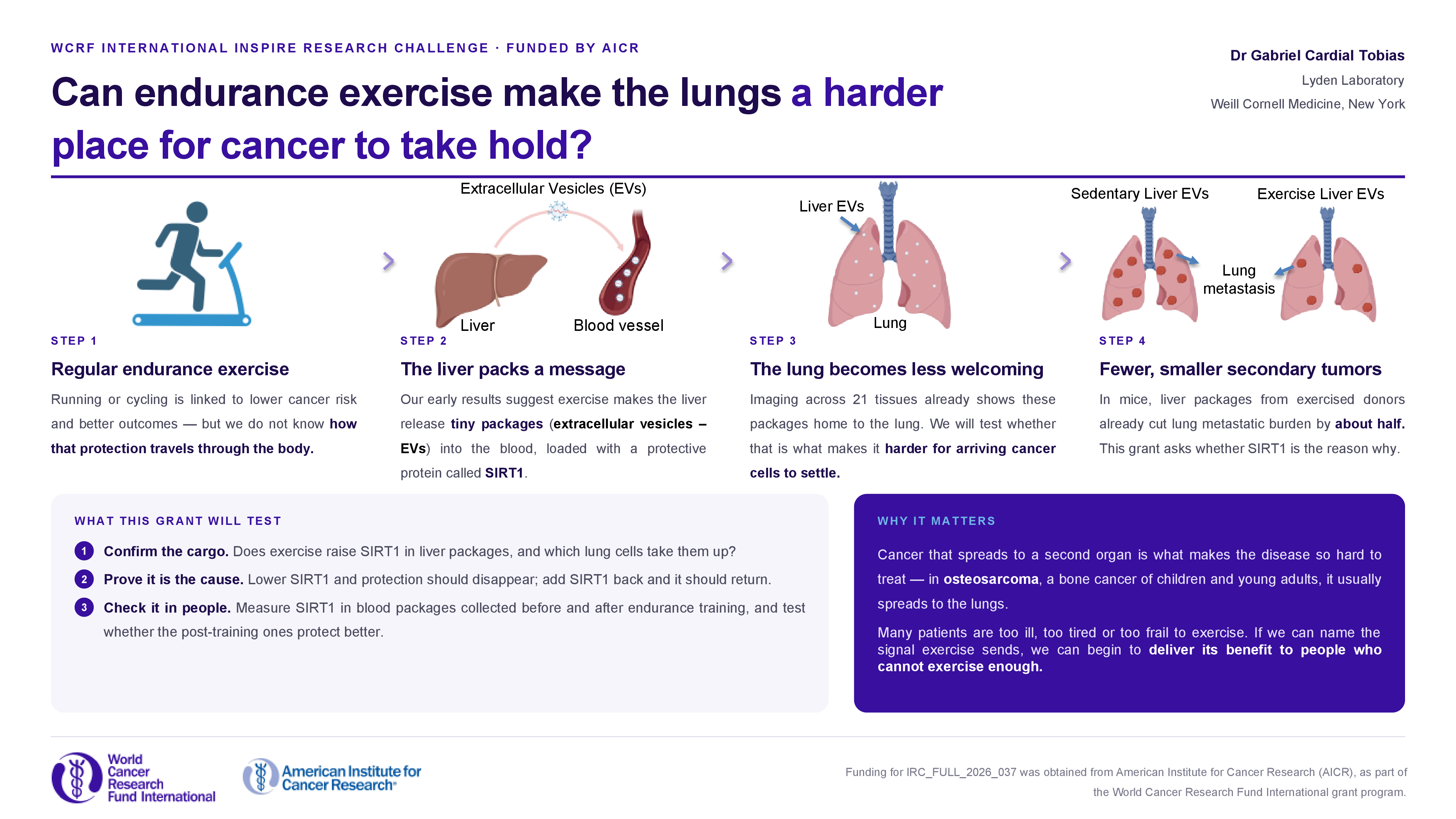
When cancer spreads from its initial site to other organs, it becomes much harder to treat. This spread is called “metastasis” and is a major reason people die from cancer. Regular endurance exercise (like brisk walking, running, or cycling) is linked to lower cancer risk and better outcomes, but many people cannot exercise enough because of age, illness, disability, or treatment side effects. To help more people benefit, we need to understand how exercise sends protective signals through the body.
Aims and Objectives:
Our own early results suggest that exercise causes the liver to release tiny “packages” into the bloodstream that carry protective messages. These packages can travel to the lungs and help make the lungs less welcoming to cancer cells. We think a key protective factor inside these packages is a protein called SIRT1, which is known to help cells handle stress and reduce harmful inflammation.
Our goals are to:
- Confirm that exercise increases SIRT1 in these liver packages and learn which lung cell types receive them;
- Prove whether SIRT1 is required for the protective effect and whether adding SIRT1 can recreate the effect;
- Test whether similar exercise-related changes occur in packages collected from people before and after endurance training.
Methods:
We will use established mouse studies to compare packages from exercised versus non-exercised donors, track where they go in the lungs, and measure changes in lung cells. We will then lower SIRT1 in the donor mice, so that the packages they release carry less of it, and test whether protection is lost; and we will load SIRT1 into packages to test whether protection returns on its own. Finally, we will measure SIRT1 in paired blood samples collected from people before and after endurance training and test whether the post-training packages show stronger protective activity.
Potential Impact:
If we find a clear protective signal carried by exercise-related packages, we may unlock new ways to predict who benefits most from exercise and could then develop future strategies that mimic the protective effects of exercise for people who cannot exercise enough.
Scientific Novelty:
Existing research in this area focuses on packages derived from tumors, whereas this study looks at packages created by host organs. This study will also test whether one cargo protein, SIRT1, is genuinely required for the protective effect, and whether supplying it is enough to produce that effect on its own. This work also looks at pre- and post-exercise packages from humans, rather than just from animal models.