




AICR
Key Takeaways:
- Since its launch with AICR support in 2006, the Mexican Teachers’ Cohort has grown into one of Latin America’s largest long-term health studies. It follows more than 115,000 women to better understand cancer and other chronic diseases.
- In the absence of a national cancer registry, the MTC developed an innovative multi-source system to identify cancer cases. It became a powerful resource for cancer research and public health.
- The cohort continues to generate evidence that guides prevention, policy and teamwork.
Twenty years ago, researchers in Mexico set out to answer a question that could not be answered only with hindsight: How do lifestyle, reproductive and environmental factors shape women’s risk of cancer and other chronic diseases over time?
“The only way to do that is to start off with a group of people who are free of the disease and wait until that disease occurs,” says Dr. Martin Lajous, MD, DSc.
That means building a cohort. Dr. Lajous now directs the Mexican Teachers’ Cohort (MTC). It is one of the largest long-term health studies in Latin America. Funding for the development of the cohort started with AICR 20 years ago.
But building the cohort was only the first challenge. For years, the team worked to solve a problem: how could they identify new cancer cases in a country without a national cancer registry? The turning point came in 2019 when the problem was finally solved.
Read on to learn how they solved the problem, the results they have learned from the MTC and how AICR has played an important role.
Long Term Partners
Funding to establish the Mexican Teachers’ Cohort began in 2006. Since then, the MTC has followed more than 115,000 women working in Mexico’s public education system. MTC generates evidence on breast cancer, heart disease, smoking, sugar-sweetened beverages, alcohol and other risk factors.
Collaboration has remained central to the mission of the MTC. “None of this would have been possible without AICR and WCRF, you believed in us,” says Dr. Lajous. “And we are forever grateful for this sustained support.”
The partnership between AICR, WCRF and MTC remains strong and ongoing. In 2020, AICR funded a grant for Dr. Lajous to study lifestyle and breast cancer risk in a prospective study of Mexican women. In 2026, AICR funded a grant for Dr. Lajous to study fiber, gut microbiome and colorectal cancer risk in a prospective study of Mexican women.
In May 2026, the WCRF International bursary helped Dr. Lajous’ colleague Dr. Liliana Gómez Flores Ramos, PhD, attend the International Agency for Research on Cancer (IARC) conference in Lyon, France. At the IARC conference, she presented work on alcohol consumption and breast cancer from the MTC.
The Story So Far
The idea for the Mexican Teachers’ Cohort grew out of a 2004 case-control study on carbohydrates and breast cancer. It was led by Dr. Isabel Romieu, Dr. Walter Willett and Dr. Mauricio Hernández. The study attracted wide attention and sparked the idea for a prospective cohort based in Mexico.
Dr. Lajous, who was based at the Harvard School of Public Health at the time, was invited to be part of the team setting up the project.
“We invited more than 115,000 women working in the public education system in Mexico to provide us with details on their health conditions, but also on their lifestyle,” says Dr. Lajous. “It was built with the intention of following up over time to be able to compare these lifestyle factors, or reproductive factors, in individuals who ended up having, for instance, breast cancer and those women who did not.”
No Cancer Registry? How MTC Overcame This Obstacle
When the cohort was set up, the program collected baseline data such as age and body mass index. Participants complete follow-up questionnaires every four to six years.
“In order to have a cancer cohort, you have to show that you can actually identify individuals who develop the disease,” says Dr. Lajous. “And this element is what really took time to develop. The main challenge was getting new cancer cases without a comprehensive national cancer registry.”
By working with different institutions in Mexico, the MTC was able to verify national IDs and achieved about 97 percent ID coverage within the cohort. The national ID numbers then enabled cross-linkage with national mortality registries, regional cancer registries and health utilization databases.
By 2019, MTC had developed a multi-source strategy to identify cancer cases using health utilization databases (discharge data, consultations, medication use) from major healthcare providers.
“We dedicated three years to develop the method and convince the stakeholders, and to get everyone together. It took a lot of conviction, and we finally got it done,” says Dr. Lajous. “That’s when we went from being a promise of a cancer cohort to a realization of a cancer cohort.”
Highlighting Key Milestones
MTC milestones help public health policy. Highlights include:
- Low cigarette smoking and cancer risk: We know about the link between tobacco and cancer. However, some Mexican women smoke occasionally or have or very low consumption. Some believe smoking only one cigarette a week is harmless. The MTC showed that even very low consumption of tobacco was associated with death.
- Type 2 diabetes, weight gain and Mexico’s sugar-sweetened beverages tax: Mexico led efforts to change diets and reduce the consumption of sugar-sweetened beverages. Lajous says the MTC conducted analysis on sugar-sweetened beverage intake, diabetes and weight gain, which has been used by policy makers.
- Sharing data: In recent years, external groups have begun seeking data from the MTC, something that Dr. Lajous is proud of. He says “For the past 20 years, I’ve been reaching out to people to let them know how important the cohort is, how key this resource is, how they all should be proud of it. And now the dial has shifted. Institutions have started reaching out to us to collaborate, but it took time.”
Building Trust
Teachers offered two advantages that made a long-term study feasible. Many teachers were familiar with doing written evaluations through an economic incentive program. Their stable employment, healthcare access and pension system made it easier for researchers to stay in contact over many years.
The cohort’s longevity also depended on trust. “You must have a participant-centered approach, in the sense that if we promise something to the participants, be sure that you deliver that,” says Dr. Lajous.
A key challenge for the team over time has been keeping engagement as teachers retire. Plus, communications have evolved from paper to electronic. To ensure consistent contact, MTC hosts monthly webinars (for all teachers, not just those who are part of the study). They also created state-specific Facebook groups for participants and moved to home visits to collect data in-person for older, less tech-savvy participants.
Importantly, Dr. Lajous stresses a two-way dialogue with the cohort. Feedback from teachers has helped shape the research agenda, leading to studies on stress and Adverse Childhood Experiences (ACEs). “One thing we’re always pushing for is that we keep our ears open to their concerns,” he says.
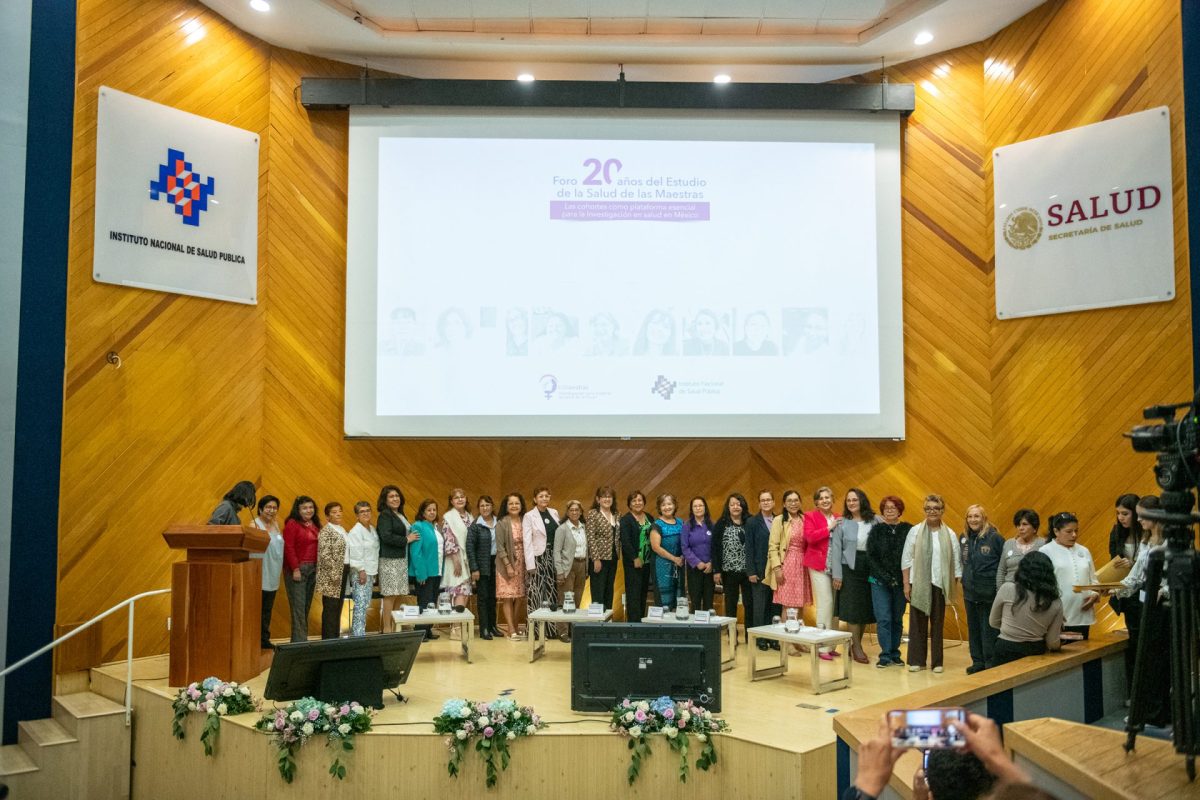
Participants celebrate the 20th anniversary of the Mexican Teachers’ Cohort (Cuernavaca, Mexico, June 2026).
Lessons Learned
A lesson for Dr. Lajous over the last two decades of setting up such a large-scale and long-term cohort is patience.
“It’s a marathon in the sense that it requires consistency over time,” he says. “Understanding that this is a long-term investment and that you need to be patient. Sometimes things are not going great, but you just need to keep moving.”
People are at the heart of the project. A dedicated team and international partnerships have been essential to the MTC. Dr. Lajous also notes the importance of relying on young researchers and making them feel invested, so that the cohort can be sustained over a long period of time.
“We are a relatively small team and collaboration with people outside of Mexico is important for us,” says Dr. Lajous. “It gives us leverage in Mexico and also because it articulates that what we’re doing is important, and people elsewhere are seeing the value in the work that we’re doing.”
Future research
As the cohort enters its third decade, its research questions are changing with its participants.
“We want to understand the intersection between aging, cognitive health and cancer. So now we have a grant where we are going to visit 15,000-17,000 participants at their homes to perform in-depth cognitive assessments,” says Dr. Lajous.
The team also plans to expand their work into environmental exposures including plastics, light at night and climate-mediated events.
“And for me, the most salient cancer-related problem right now is colorectal cancer, which is increasing much more dramatically than other cancers. It’s currently the leading cause of cancer mortality in Mexico, but we have very limited strategies for prevention and control of the disease,” explains Dr. Lajous.
Reflecting on the last 20 years, Dr. Lajous says, “I’m most proud of how this project has changed people’s lives and will potentially change a lot more people’s lives.”
Looking back, the cohort’s greatest achievement may be exactly what it set out to create – evidence rooted in real lives, sustained by trust, with the power to inform future generations about cancer prevention.